
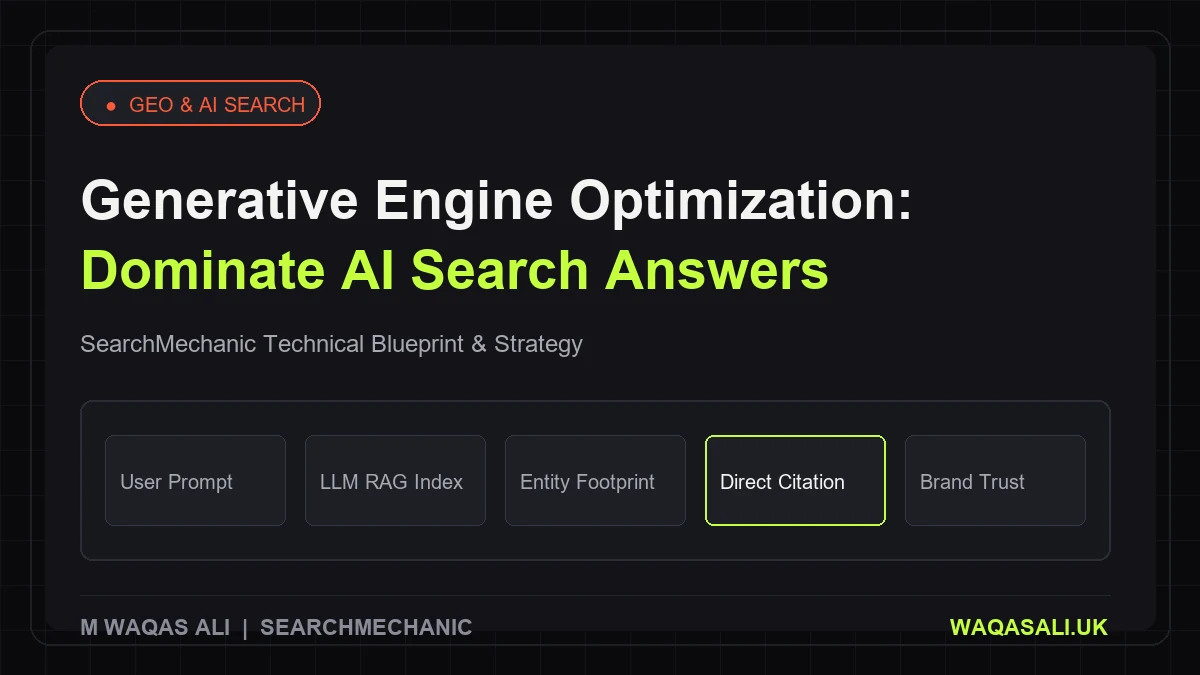
Search is being redesigned from the ground up. Google's AI Overviews now appear above the organic results for a significant portion of informational queries. ChatGPT and Perplexity are handling research questions that users previously would have typed into Google. The businesses getting cited in these AI-generated answers are gaining authority and traffic — the ones being ignored are watching their organic clicks decline even when rankings hold steady.
GEO — Generative Engine Optimization — is the practice of structuring your website, content, and off-page presence so that AI language models include your business when generating answers. This guide documents exactly what I implement for my consulting clients to earn AI citations and maintain visibility as the search landscape changes.
How AI search models source their answers · Entity optimisation and knowledge graph signals · Content structure for AI citation · llms.txt and structured data for LLMs · Off-page authority signals that AI models trust · Monitoring your AI search presence.
1. How AI Search Models Decide What to Cite
AI search models — whether Google's Gemini generating Overviews or Perplexity's answer engine — don't rank pages the way traditional search does. Instead, they retrieve content from a curated index of trusted sources, apply retrieval-augmented generation (RAG), and synthesise an answer that they attribute to specific sources.
The key insight is that AI models heavily favour sources with high entity coherence, clear factual claims, and multi-source corroboration. A page that says "we offer SEO services" once in a generic paragraph is much less likely to be cited than a page that contains specific, verifiable claims about the business, its credentials, and the outcomes it has produced — with those same facts appearing consistently across other authoritative web sources.
- 🔍 Retrieval triggers: AI models retrieve your content when queries semantically match your page's entity footprint — not just your exact keywords.
- 📑 Citation preference: Structured, fact-dense content (lists, tables, specific claims with numbers) is cited more frequently than narrative prose.
- 🔗 Trust signals: The same entity (your business) being referenced on Wikipedia, industry directories, news articles, and other high-authority domains increases citation likelihood significantly.
- ⚡ Speed matters: AI crawlers penalise slow-loading pages. A fast, well-structured page is more likely to be indexed and retrieved by RAG pipelines.
2. Entity Optimisation: Making Your Business Unambiguous to AI
Traditional SEO optimises for keywords. GEO optimises for entities — the specific, identifiable things in the world that AI models understand: businesses, people, places, products, and concepts. The clearer and more consistently your business is represented as an entity across the web, the more confidently AI models will cite it.
Schema Markup as Entity Definition
Your JSON-LD schema is the clearest, most direct way to tell AI crawlers exactly what your business is. The waqasali.uk homepage uses a ProfessionalService schema with a comprehensive knowsAbout array listing every SEO discipline I practise, sameAs links to my LinkedIn and Twitter profiles, and areaServed to define geographic coverage. This creates a machine-readable entity definition that AI models can reliably retrieve and cite.
Consistent NAP and Business Details
Name, contact details, and service descriptions should be identical across your website, Google Business Profile, LinkedIn, and any directory listings. Inconsistencies create entity ambiguity — AI models may merge your entity incorrectly with another business, or avoid citing you to prevent surfacing incorrect information.
If your business name is common or shared with another entity, you need additional disambiguation signals: a unique tagline, a specific geographic qualifier, a precise service description, and cross-references from trusted external sources that use your full business name in the correct context.
3. Structuring Content for AI Citation
The content patterns that AI models most reliably cite are the same patterns that strong traditional SEO rewards — but with even higher standards for specificity and structure. The research on AI Overview citations consistently shows that direct, fact-first answers score significantly higher citation rates than narrative explanations.
- ✓ Lead with the answer: The paragraph immediately below an H2 should directly answer the likely question behind that heading. AI models extract these as featured answers.
- ✓ Use numbered or bulleted lists: Structured lists are disproportionately cited in AI Overviews compared to their frequency in source content. Format key takeaways as scannable lists wherever appropriate.
- ✓ Include specific statistics and claims: "Clients see an average 41% increase in organic traffic within six months" is citable. "Clients see improved traffic" is not.
- ✓ Cite external authority sources: Linking to Search Engine Land, academic research, or government statistics signals that your content is research-backed, which AI models use as a trust proxy.
- ✓ Define terms explicitly: AI models are more likely to cite your page when answering definitional queries if your page contains a clean, specific definition of the relevant concept.
Want your site optimised for AI search?
I'll audit your entity footprint, schema markup, content structure, and off-page signals — and give you a GEO action plan at no charge.
4. The llms.txt File: A Direct Signal to AI Crawlers
The emerging llms.txt standard (analogous to robots.txt for LLMs) provides a plain-text document at the root of your domain that tells AI crawlers what your website covers, who it belongs to, and which pages are most relevant to retrieve. While not yet universally adopted by all AI systems, Anthropic's Claude, Perplexity, and a growing number of AI agents already read and respect llms.txt.
An effective llms.txt for a service business like mine includes: the business name and primary expertise areas, a structured list of key pages with descriptions, the author's credentials and E-E-A-T signals, geographic service coverage, and explicit permission statements for AI training and retrieval. This website's llms.txt is fully configured for AI crawler access and updated to reflect all services and blog content.
5. Off-Page GEO: Building the Citation Web AI Models Trust
AI models are trained on the web and retrieve from indices that heavily weight authoritative sources. Off-page GEO means building the same kind of citations and mentions that traditional SEO values — but with explicit attention to the signals AI models use to establish entity credibility.
- 📰 Topical mentions in authoritative publications: When a credible industry publication or news site mentions your business in the context of your expertise, AI models learn to associate your entity with that topic.
- 🔗 Guest articles on industry sites: A bylined article on a respected industry site creates a high-quality entity link between your name and your expertise, with the publication's authority lending credibility.
- 🏛️ Directory and association listings: Business associations, professional directories (especially industry-specific ones), and chambers of commerce listings are frequently in AI training data and retrieval indices.
- 💬 Forum and community presence: Substantive, expert contributions on Reddit, Quora, LinkedIn, and specialist forums are indexed by AI systems and can drive citation when queries match your areas of expertise.
6. Monitoring Your AI Search Presence
Unlike traditional SEO, there is currently no single dashboard showing your AI citation frequency across all LLMs. The monitoring approach I use for clients combines manual spot-checking, brand monitoring tools, and structured tracking of referral traffic patterns.
For manual spot-checking: run your target queries in ChatGPT, Perplexity, and Google with AI Overviews enabled. Note which sources are cited. For brand monitoring: set up Google Alerts for your business name and key branded terms — AI-driven content that references you will often surface in news and web results. For traffic analysis: referral traffic from AI platforms (ChatGPT, Perplexity, Claude.ai) is increasingly visible in GA4 and Search Console. Monitor for new referral sources and any "dark traffic" spikes that lack a clear source, as these often originate from AI-assisted research.
1. Add or update your llms.txt at your domain root with your key services and author credentials. 2. Review your JSON-LD schema and expand knowsAbout to cover every topic you want to be cited for. 3. Audit your three most important pages for fact density — add specific numbers and claims where you've been vague. 4. Run your five most important service queries in Perplexity and note which competitors are being cited and why.