
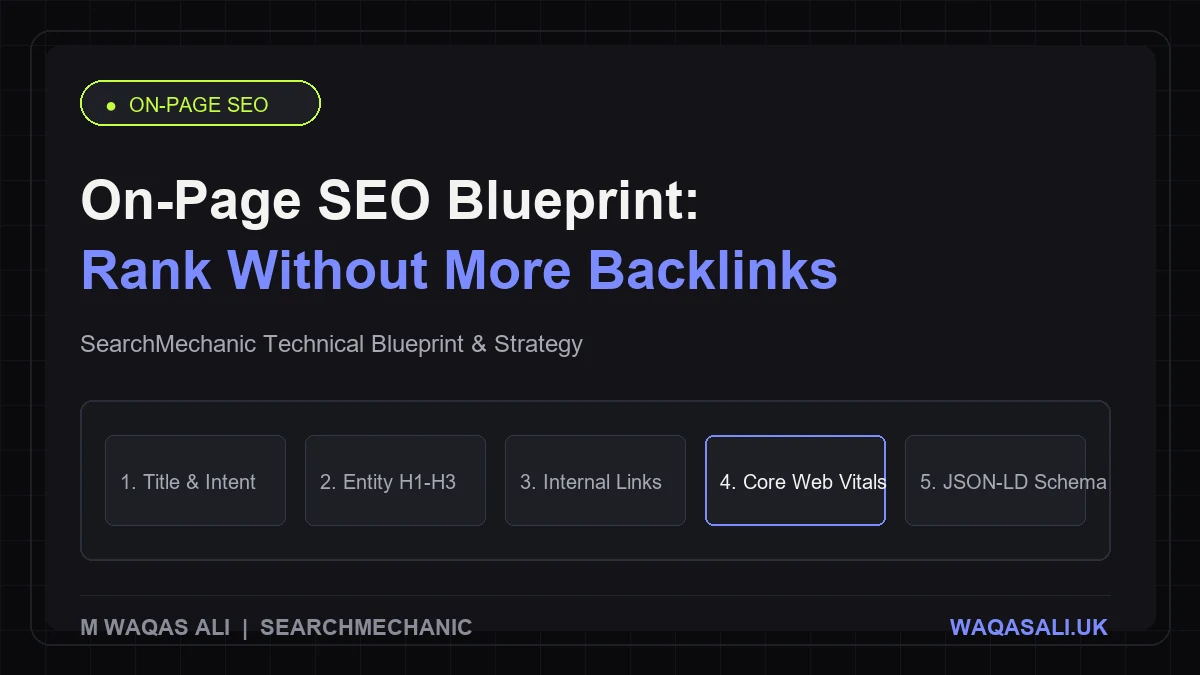
On-page SEO is the highest-leverage work you can do on any website. Before spending a single penny on link building, the content on your pages needs to be structured in a way that Google can fully understand, trust, and reward with rankings. After eight years of consulting for businesses across the US, UK, and Europe, I consistently see the same on-page mistakes holding back otherwise good websites.
This guide covers every on-page signal that matters in 2026 — including how Google's understanding of entity relationships and E-E-A-T (Experience, Expertise, Authoritativeness, Trustworthiness) has changed what "optimised content" actually means.
Title tag architecture · Meta description strategy · Heading hierarchy (H1–H4) · Keyword placement and density · Content structure and E-E-A-T · Internal linking · Image optimisation · Core Web Vitals · Schema markup basics.
1. Title Tag Architecture That Actually Moves Rankings
Your title tag is still the single most powerful on-page ranking signal. Google uses it to understand what the page is about and it directly controls your click-through rate in search results. A weak title tag wastes both.
The formula that consistently outperforms is: Primary Keyword + Secondary Angle + Brand. Keep it under 60 characters, front-load the primary keyword, and avoid stuffing. Every page on your site should have a unique title — duplicates are one of the most common technical errors I find in competitor audits.
- ✓ Place the primary keyword in the first 3 words of the title where possible.
- ✓ Use your brand name at the end, not the beginning (unless you're a very well-known brand).
- ✓ Match the title to search intent — informational queries need different titles than transactional ones.
- ✓ Avoid using the same title on more than one URL. Google may pick an alternate title from your H1 or body content instead.
- ✓ Test CTR by monitoring Google Search Console impressions vs. clicks after title changes.
2. Content Structure: How Google Reads Your Pages
Google doesn't read your content the way a human does. It analyses the semantic relationships between headings, paragraphs, lists, and embedded entities. The better your content structure, the more precisely Google can understand what your page is authoritative on — and which queries to rank it for.
Heading Hierarchy (H1 → H2 → H3)
Every page needs exactly one H1, and it should contain your primary keyword in a natural, specific way. H2s should map to the major sub-topics of the page. H3s go inside H2 sections for specific details. This hierarchy tells Google how the information is organised and helps it extract featured snippet answers from the most relevant sections.
The Lead Paragraph
Google's featured snippet algorithm heavily weights the paragraph immediately following an H2. Write lead paragraphs that directly answer the likely question behind each section heading — this is the single easiest way to earn featured snippets for longer-tail queries.
Using H2 and H3 tags for design purposes rather than semantic hierarchy. If your CMS lets developers choose heading sizes for visual reasons, make sure the heading order in the HTML still follows H1→H2→H3 regardless of what it looks like visually.
3. E-E-A-T: What Google Wants to See in 2026
Experience, Expertise, Authoritativeness, and Trustworthiness (E-E-A-T) isn't a ranking algorithm by itself, but it is the framework Google's human quality raters use to evaluate pages. Pages that score well on E-E-A-T signals consistently outperform those that don't, especially in YMYL (Your Money or Your Life) niches like finance, health, law, and business services.
- 👤 Author attribution: Every blog post and article should have a named author with a bio, credentials, and links to their wider presence (LinkedIn, publications, etc.).
- 🔗 External citations: Link out to authoritative sources. Google treats outbound links to credible sites as a signal that your content is research-backed. A link to a Google's official SEO documentation or a government agency is worth including when relevant.
- 📊 First-hand experience: Include specific numbers, case studies, and personal observations. Vague generalities score poorly. "Clients saw an average 41% increase in organic traffic over 6 months" is far stronger than "clients got better results."
- 🏢 Business signals: A clear About page, physical or registered address, and consistent NAP (Name, Address, Phone) across the web all feed into trust signals.
Want an E-E-A-T audit on your website?
I review your content, author signals, schema markup, and off-page authority — and give you a prioritised fix list with no obligation.
4. Internal Linking: The Most Underused SEO Lever
Internal links pass authority between pages, help Google discover and crawl your content, and signal which pages are most important to your site's topical cluster. Most websites I audit have either too few internal links or link randomly without any strategic intent.
The correct approach is to build a deliberate hub-and-spoke architecture. Your most important commercial pages (the "hubs") should receive the most internal links from supporting content (the "spokes"). Every blog post and article should link back to at least two or three relevant service pages, and service pages should cross-link to related service pages.
- ↗ Use descriptive, keyword-rich anchor text — not "click here" or "read more."
- ↗ Link from high-authority pages (like your homepage) to pages you want to rank.
- ↗ Fix orphan pages — any page with zero internal links receives zero authority from your site.
- ↗ Audit your link depth — important pages should be reachable within three clicks from the homepage.
5. Core Web Vitals: Performance as a Ranking Signal
Since the Page Experience update, Google uses Core Web Vitals as a ranking tiebreaker. When two pages have comparable content and authority, the faster, more stable one tends to rank higher. LCP (Largest Contentful Paint), CLS (Cumulative Layout Shift), and INP (Interaction to Next Paint) are the three metrics to track.
On this website, I've implemented requestAnimationFrame-throttled scroll listeners, will-change compositing hints on animated elements, and fetchpriority="high" on above-the-fold images. These optimisations are the same ones I implement for client websites as part of my technical SEO work. For a deeper look at the technical side, see my GEO guide for how site speed also affects AI search citation rates.
LCP under 2.5 seconds · CLS score below 0.1 · INP under 200ms. Measure using PageSpeed Insights on both mobile and desktop — Google's lab data comes from Lighthouse, but field data from CrUX is what counts for ranking.
6. Schema Markup: Telling Google Exactly What You Are
Schema markup (JSON-LD) gives Google unambiguous, machine-readable information about your business, content, and credibility signals. It is not a direct ranking factor in isolation, but it unlocks rich results (star ratings, FAQs, breadcrumbs) that dramatically improve click-through rates, and it helps build the entity understanding that underlies rankings in competitive niches.
For a service business like mine, the essential schemas are: ProfessionalService or LocalBusiness on the homepage, BlogPosting on every article (as you can see implemented on this very page), BreadcrumbList for navigation context, and FAQPage on any page with FAQ sections. Verified implementations can be checked using the official Schema.org Validator. The Review and AggregateRating schemas unlock star snippets in search results and are well worth adding if you have legitimate, verifiable reviews.